
I think I may be coming around to Brahms’s larger orchestral works. On this blog, I’ve opined the occasional colourfully distasteful thing about the old master’s orchestral works while praising the beauty, craft, and inspiration of his chamber music. I’ve been smitten with his C minor Piano Quartet for years and I’m awestruck by the effortless way in which he could fill reams of staves with melodic material that’s – at the same time – distinctly and discretely unique.
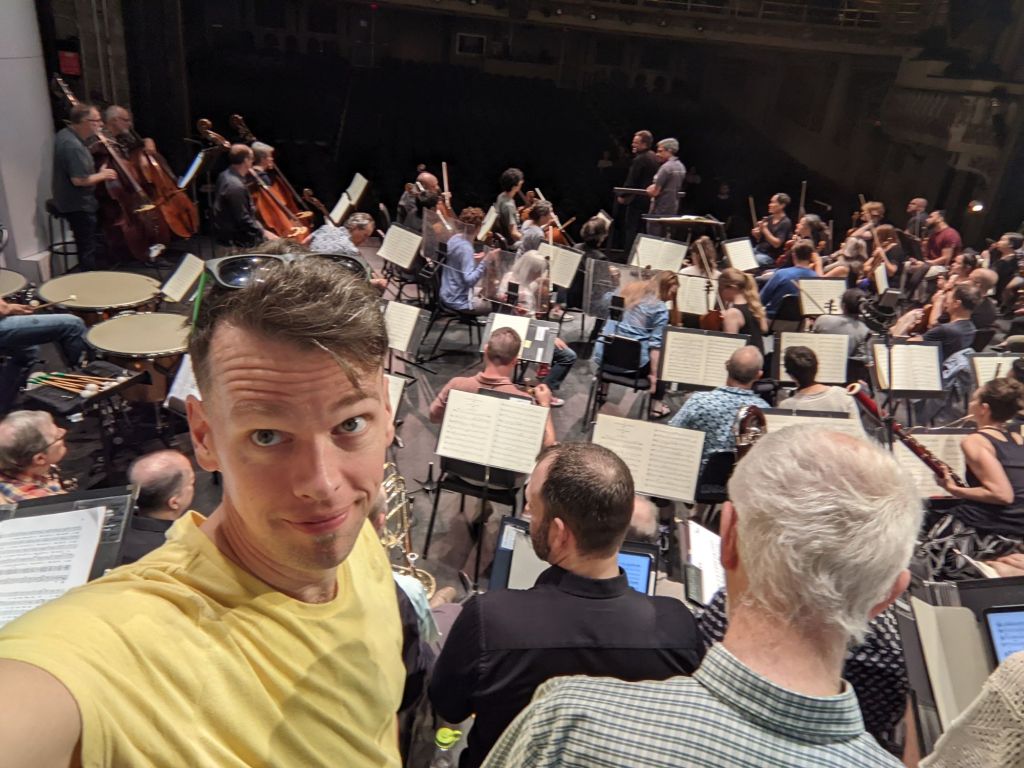
This weekend, I’m singing in the choir of production of Brahms Requiem with the Victoria Symphony and I’ve been cramming the music like crazy. There is a LOT of it. A reasonably paced performance can easily hit 80 minutes. The music is incredibly taxing – but also incredibly satisfying – to sing.
The text of the piece is unlike most Requiems in a few distinct ways. For one, it’s not in Latin. At the time of its composition, the language of Latin was very much a relic owned by society’s elite classes. By setting it in German, Brahms is directing the music away from the most privileged of us and something for the common man. This is a connection to Beethoven’s 9th symphony – the spectre of which loomed massively over the symphonic output of composers forever after.
Brahms sets up the text in a really interesting symmetrical formation around the middle fourth movement – the only one lacking a reference to death. And the whole piece is bookended by movements offering comfort and hope for the living and the dead (1st and 7th movements respectively).
I – Selig sind die da Leid tragen… (Blessed are those who mourn). | II – Denn alles fleisch, es ist wie Gras… (All flesh is like grass). | III – Herr, lehr doch mich, daß ein Ende mit mir haben muß, (Lord, teach me that I must have an end). |
| IV – Wie lieblich sind deine Wohnungen, Herr Zebaoth! (How lovely are your dwellings, oh lord of hosts!). | ||
| V – Ihr habet nun Traurigkeit… (You now have sorrow). | VI – Denn wir haben hie keine bleibende Statt (For here we have no permanent place). | VII – Selig sind die Toten (Blessed are the dead). |
The amount of work that goes into making music like this makes it easy to forget how much of a tremendous undertaking it is. The mountainous scale of the work put in can easily dwarf your appreciation of the music itself, if you let it. The life raft came to me when at one point, Christian Kluxen – our leader through this massive mass of music bellowed out, “It’s amazing that you dare to do this!” – I think he was trying to goad the sopranos into action. But it felt like it was for all of us.
 Chris Sivak | Composer